Pooja Agarwal
1313240
II PSEng
Exploring the themes of Japanese immigrant writings in America and the clash of cultures and generations through Hisaye Yamamoto’s story, “Seventeen Syllables”.
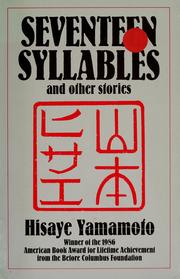
Hisaye Yamamoto was a contemporary Japanese American writer who was best known for her short stories through which she intimately explored the experiences and conflicts of the Japanese immigrants in America. She was born in 1921 and was a Nisei i.e a second-generation Japanese born in America to Japanese-born immigrant parents. Growing up in America, Yamamoto soon became aware of the conflict between the American culture she was exposed to and the japanese way of life that her parents tried to inculcate in her and these experiences as a second generation Japanese living in America had a lasting influence on her work. The disconnect constant conflict between the American and Japanese culture and the generation gap between Isie parents and Nisei children was of immense concern to her and is a recurring theme in most of her works. Her most popular work is a collection of short stories called, “Seventeen Syllables and other stories” which was published in 1988.
Yamamoto's stories are often compared to the poetic form, haiku, described as "layered in metaphor, imagery, and irony, but never wordy or given to digression."
The stories in the above mentioned collection mostly deal with the experiences of first generation Japanese immigrants (Issei) and their Nisei children. The title is drawn from one of the stories within the collection and refers to the structural requirements of Japanese haiku poetry. Many of the stories have admittedly autobiographical content, making references to the World War II Japanese internment camps, to life in Southern California during the 1940s and ‘50s, and to the experience of being a writer.
“Seventeen Syllables” is Yamamoto’s most popular and definitive short story through which she discusses the the relatively restrained interaction between Issei (first generation) and Nisei (second generation) as a result of both cultural prescription and language barrier and the limited status of Japanese women who immigrated to America after marriage. The story traces the strained and disconnected relationship between Rosie and her Isei mother, Mrs Tome Hayashi. Rosie grows up attuned to the American culture and is more comfortable in english than she is in her native language-Japanese. She struggles to grasp the essence of Japanese culture,language and poetry that is central to her mother’s life. Mrs Hayashi is a talented writer and writes Haikus for the local Japanese newsletter. One day during the harvest season, the editor of the newspaper visits Mrs Hayashi and rewards her with a Hiroshige print due to her contributions. However, since it is in the middle of harvest season, her husband is irked by the fact that instead of helping in the field, his wife is wasting her time receiving presents for her hobby.and burns it. Mr Hayashi doesn’t support his wife’s talent and is infact so angry that he burns the painting given to her by the editor. We later learn that Mrs Hayashi feels stuck in her loveless marriage and only married Rosie’s father because her wealthy lover in Japan rejected her after she gave birth to a stillborn child. Fearing that Tome’s reputation is ruined, an arranged marriage is organized by her aunt who resides in the US. Tome asks Rosie to refuse marriage due to the experiences which she has undergone.
In this story, Yamamoto explores some pertinent aspects of the Japanese-American experience. The main themes of the story are the gap between the older generation of Japanese immigrants and their children who grow up as Americans. There is an apparent clash between these two generations since the former practices the ancient Japanese way of life while the latter practices the modern American culture. The latter generation views the ancient one as backward and it ignores many essential aspects of culture which it is expected to experience This divide is further emphasised by the language barrier depicted in the story. For Tome, Japanese is the most natural form of communication and infact an art for her authorial sensibilities, however her daughter Rosie has limited knowledge of Japanese due to her socialization into the American way of life and prefers english over Japanese. Further, Rosie is unable to grasp her mother’s need to write Haikus and practice her japanese culture while Mrs Hayashi fails to accept the fact that her daughter is growing up in an individualistic,highly independent society which is stark contrast to her familiar Japanese culture.
This generational gap discussed in this story is a an important aspect of many Japanese-Americans’ lives and has been a general concern for most Japanese-American writers.
Another, theme seen in the story is that of the position of women in Japanese-American families. Here we see that Mrs Hayashi is stuck in a loveless marriage where her husband does not support her talents and she struggles to live in a culture so vastly different from the one she grew up in. This seems to be the case for a lot of Japanese women who settled in America after an arranged marriage, where they had to adapt to a new way of life with little support from people around them.
Thus, by examining Yamamoto’s story we gain a better understanding of the Japanese-American experience and how American culture has influenced Japanese immigrants’ thought and writing.
Sources:

No comments:
Post a Comment