Thursday, 12 February 2015


INFLUENCE OF AMERICAN CULTURE ON JAPANESE LITERATURE 

An Additional English Assignment

By: Akritee
                     Pooja Agarwal
                                 Sanjana Susan John
                      Nivedita Dogra
                            Mishanka Odoyoth
                 Divya Swamy
             Avani  Jain


For the Register numbers please refer to the bottom of the respective posts.

INTRODUCTION


One of the most intrinsic cultural bonds that the United States has formed in its long history is also an often overlooked one. The cultural ties between the United States and Japan are immense even at the most basic level and weave their way into dozens of subcategories of both countries' cultures.  Japan was influenced significantly by America during the era of Americanization. The Japanese took on clothing, music, and the English language in common conversation.the Japanese literature as we know today is the by product of a lot of sociocultural influences of the west primarily the american . this can be attributed to the large scale immigration in the 18th century by the Japanese to the US. though the cultures of the both countries were separated by decades of cultural evolution . the Japanese  tradition can be dated back as far as 710, the starting of the Nara period,categorized by Man'yoshu (Collection of Ten Thousand Leaves), an anthology of 4,500 poems composed by people ranging from unknown commoners to emperors and compiled around 759. this period was succeeded by the heian period from 794 to 1185 the most significant work being Konjaku monogatari (Tales of a Time That Is Now Past) around 1120 added a new dimension to literature. This collection of more than 1,000 Buddhist and secular tales from India, China, and Japan is particularly notable for its rich descriptions of the lives of the nobility and common people in Japan at that time. the periods of kamakura muromachi wivh ended in 1573 produced works like Yoshida Kenko's Tsurezuregusa (Essays in Idleness)  , a work marked by penetrating reflections on life .  the edo period from 1603 to 1868 which followed Ihara Saikaku, who realistically portrayed the life of Osaka merchants, and Chikamatsu Monzaemon, who wrote joruri, a form of storytelling involving chanted lines, and kabuki plays. These writers brought about a great flowering of literature. Later Yosa Buson composed superb haiku depicting nature, while fiction writer Ueda Akinari produced a collection of gothic stories called Ugetsu monogatari. after this came the meji period in which the modern japanese writing as we know started to take shape.Futabatei Shimei's Ukigumo (Drifting Clouds) [1887] won acclaim as a new form of novel. Akutagawa Ryunosuke, wrote many superb novelettes based on his detailed knowledge of the Japanese classics . this time also represents the first major migration pattern of japanese going to america. when they came back the new styles of american litrature folled them to japan. it is later through this new found alliance with the west that writers like Kawabata Yasunari came to international recognition. and later won the nobel prize.


NIVEDITA DOGRA
1313239
4PSENG

THE CULTURE OF JAPAN


Akritee.
1313270.
4PSEng.

The culture and philosophy of Japan has been a mystery for the Western world since times immemorial. Its magnificence and splendour have been commercialized through Western culture and now enjoys a status as one of the world's top economic powers. A very interesting aspect of Japan is towards its attitude to work and superb business ethic. Karoshi is the Japanese word for "death from overwork." The widespread image of Japanese businessman as tireless machine for corporate welfare is moderately correct. However, there it would be wrong to imply that an average Japanese employee works harder in comparison to an American worker.
The culture in Japan is a multi-layered and complex structure that has been emerging within itself and creating new layers since for a long time now. A stereotypical Westerner has a rather incomplete interpretation of Japanese culture. One of the first images that springs to one’s mind is that of an ancient Samurai warrior exercising his heavy sword, or the picture a young Geisha, pouring tea and serving sushi. While these components do play a role in the entire concept of Japan as a whole, the entire meaning and history of the nation is much larger than that. 
 Japanese folks view themselves as attuned to nature. Majority of urban Japan is an industrialized, built-up mess. This is the consequence of ad hoc redevelopment after the second world war. In Japan, there is a word, omote, which refers to the civic, formal, and conventional aspects of behaviour. This refers to deep-seated patterns of behaviour, for instance how close to one another individuals stand, or who shakes whose hand first at a meeting. It also can make reference to behaviour in business undertakings and events in a professional setting. Ura, which is more valued, refers to the private, informal, and unconventional aspects of culture
Japanese people see this manner of behaviour as more respected and expressive, however, one merely acts this way in proximity with close friends or family members. The Japanese give a lot of importance to the outside appearances. This however does not stand for the fact that they do not value what is private and hidden, but it aims to imply the fact that copious prominence is placed on an individual's presentation and appearance.


Social ranking and status play a part in many major institutions that one goes through in a lifetime. In Japan, everyone is aware of everyone else's age. In some companies, newsletters that display the ages of employees are produced for internal distribution. Vertical ranking, based mainly on age, determines everything from the location of desks in a classroom to the order in which cups of tea are distributed. These rankings are even pervasive in the language, which has diverse ways of speaking others in regard to their age, whether older or younger.
Conventionally, the Japanese lay great importance on the concept of wa, or group harmony. The importance of the common greater good is of way more importance than laying emphasis on one's own needs. This norm is applied in schools, as well as social groups and, later in life, the workplace.
The inferior partner in a relationship, whether personal or business, must alleviate their own wants, thoughts, and opinions to that of the superior, so as not to cause the superior to lose face or be humiliated. The appearance, or tatemae, is more important than the reality, or honne. Although this may appear as hypocritical or negative to the eyes of westerners, to the Japanese this may be completely normal.


The History of Japanese immigration and their adaptation to American culture

 MISHANKA ODOYOTH
1313237
4PSENG

Hawaii saw the establishment of sugar plantations in 1835 and these sugar plantations required immense man power. Chinese labourers were imported to help with this in 1852. By 1865 many Chinese left and joined other jobs leaving the Hawaii foreign minister seeking for help, which he found in Japan. On May 17, 1868 the Scioto sailed from Yokohama for Honolulu with over 140 Japanese residents; men, women and children. The plantation labour was hard on the immigrants who were skilled in cooking, sewing, baking, pottery, brewing and martial arts. Their monthly wage consisted of four dollars. It is clear that the fact they migrated to America was for the job opportunities which their land seemed to not offer.
The United States passed the Chinese Exclusion Act in 1882 which prohibited further Chinese immigration. They faced discrimination and were not welcome in the land of the Americans. The increase in Japanese in California led to an anti-Japanese movement and in San Francisco students in schools were segregated into Japanese and Americans, a number of them were ordered to attend schools only for Chinese. This insulted the Japanese government and President Theodore Roosevelt, wishing to maintain a good harmonious relationship condemned the segregation. It was only after that the States allowed Japanese who had already been to America to return with their immediate family members; this was known as the Gentleman’s Agreement.
Under this agreement Japanese immigration continued and there was a gradual shift in the paradigm where the immigrants that were once male dominated turned into a family oriented people seeking permanent settlement premise. This was evident because of the marriage style that was being followed during this period of 1909 to 1920 called picture brides where the marriage would be fixed and done with the man overseas and they would meet for the first time upon the lady’s arrival at the pier in Honolulu.


The United States senator, Hiram Johnson of California though, wanted a ban on all immigration from Japan. Hoping to avoid insulting the Japanese government yet again the secretary of State, Charles Evans Hughes requested the Japanese ambassador to write a letter bringing to the limelight the past gentleman’s agreement. The ambassador in the letter hinted at the consequences the exclusion of Japanese would have upon the relations between the countries, which was perceived as a “veiled threat”. Post that, President Coolide signed the immigration act of 1924 which banned all Japanese immigration till around 1952.

The continuous flux that japan was kept in when it came to migration undoubtedly had its effect on the state of the people and the government. The small size of japan led them to seek for a fulfilment of their needs outside their country. America on the other hand polite in the beginning seemed to no longer want to entertain their presence. The ban on the immigration hit home. To fit in and avoid discrimination there was an obvious adaptation of the American culture by the British. The process of acculturation and assimilation was strong, judging from the fact that the Japanese people had to fit in to the bigger culture of America and were influenced by it more than they could cause am influence on it. They faced a lot of social disabilities, for example they were not allowed own land or become united states citizens. The children of the Japanese were encouraged to adopt white collar jobs and move out of the grasps of farming. This is what drove them to forming close relationships and bonds with the Caucasians, so that they could stand a chance at climbing the social ladder and gaining acceptance in the society. 

Japanese American writing form an Immigrants Perspective


DIVYA  SWAMY
1313226
4PSENG


There has been a drastic redefinition of what native Japanese literature is with geographic mobility and the interface with various ethnic groups. Japanese writing in English has largely been seen as a representation of Japanese ethnicity and their trial and tribulations as Immigrants. Japanese culture that these peoples carry along with them across international borders has today grown excessively cosmopolitan and cross cultural. The quest of “literary nationality”, in a country like America can get a little problematic due to the multiplicity of ethnic groups and large influx of immigrants.
In 1865 many young men from japan travelled to the United States of America to study medicines, sciences, law, philosophy and aesthetics. They also came to carve a niche for themselves in the west. The best known amongst such men was Yone Noguchi. He arrived in the United States   in 1893 and worked as a news reporter for a Japanese language newspaper in San Francisco. There he was a student cum house boy at the poet, Jaquin Miller’s house on Oakland. In 1904 Noguchi returned to japan over the Russo- Japanese war.
Toshio Mori (1910-1980), writer of Japanese descent to be facilitated and recognised the American literary was inspired by Sherwood Anderson. He wrote prose based on the life descriptions of Japanese’s emigrants. The publication of his first book was deterred by the outbreak of World War- II. He later went on to make his literary debut in 1949 with yakohama, California which was later followed up by, “women form Hiroshima” and “the chauvinist”. As one can see from the above mentioned authors these authors have had a strong political motivation and the contextuality  of the text must not be overlooked .
The tradition of Japanese American literature can be traced back to first generation immigrants through the traditions that they have kept alive through newspapers and other mediums such as novels and short stories. Between 1907 to 1932, Okina was a resident of the United States. He played a major role in the Japanese- American literary world in the pacific North West. One of his works include an essay known as “declaration of emigrant literature” (1920).

Japanese- American writing therefore becomes a product of the curious east and the west and the manner in which the east adapts to the needs and demands of the west.

A look into Anime


INFLUENCE  OF  AMERICAN  COMICS  AND  SUPERHEROES  ON                                                      JAPANESE  MANGA  AND  ANIME

Sanjana Susan John
1313248
4PSEng

American Superheroes vs Japanese Superheroes

Martin Winckler in Super Heros defines a hero as as one “who confronts extraordinary adversaries and also superhuman difficulties to save his life or someone’s life or to defend universal values.The hero is the one we want to imitate. He’s escaping from danger because of his strength, his great intelligence or simply because he is good.” (Winckler 2003, 6). The word superhero is connected with comic books in the USA as was first applied to the character of Superman in 1938. Winckler also says that the superhero need not always be “good” but could also be an enemy of sorts, which is seen in characters like the Hulk or X-Men who are considered a threat to the human mind. Superheroes have different agendas. For example, Superman fights for justice, Batman fights for revenge while Hulk fights because he is angry. Moreover, superheroes are not static characters but are constantly evolving and becoming stronger. One common characteristic of superheroes is that they all have a weakness (Superman’s weakness is Kryptonite). Some have double identities (Diana Prince/Wonder Woman), and they also have allies (Spider Man has Mary Jane and his aunt May). Also, a superhero always has an enemy and the superhero and villain are always paired : Batman and Joker, Spider Man and the Green Goblin etc.

Similar to American Comics, there are superheroes and villains in Japanese anime and manga, like Supah Jaianto (Ishii, 1956), Astroboy (Tezuka, 1963-1966) and Godzilla (Honda, 1954). Japanese superheroes are either humans or robots or monsters, and they can be male or female. Some are extra-terrestrial while some are products of technological experiments similar to the superheroes in American comics. Rejane Hamus-Vallee talks of a prevailing characteristic of Japanese superheroes : the link between the human and the machine. Astroboy, made by Osamu Tezuka and Major Kusanagi in Ghost in the Shell, are both machines that think and feel like humans. In some mangas, the machines are created in such a way that the humans can go inside the machine in order to pilot it (seen in the character of Actarus in Mazinger Z). There are also certain manga where the characters are half human and half machine as seen in the character of Cobra in Space Adventure Cobra who has a gun under his left arm.Such mutations are seen in most Japanese manga and cartoons apart from those with superheroes. In Highschool Kimengumi, the characters become small while their heads become large when they do something foolish. This technique is called Super Deformed Technique or the Chibi Technique and is commonly used in manga because the emotion shown through this is easily understood by the reader/spectator. The quest for identity is shown through the allegory of mutation, which consequently leads to an exploration of the future of humanity.

The superheroes in the US comics influence Japanese superheroes. This explains why Japanese television has a show called Spider-Man (Toei, 1978). Toei purchased his rights to change Marvel’s Spider Man into a superhero in Japan. In the show, the man Yamashiro Takuya has an alien bracelet which is capable of creating webs like the original Spider Man. The Japanese Spider Man is different from Marvel’s Spider Man, the only similarities being the costume and the web abilities.

Manga vs Comics

Manga is often compared to American comics. In the USA, Comics were introduced at the same time as superheroes, in the 30’s. Manga and Comics are similar in some ways. Both are published by major publishing firms specializing in that particular area, like DC or Marvel Comics. Both come from pulps and comic strips where the medium, distribution, layout and origins of heroes are common.

The differences are seen in the fact that Japanese production is larger as Manga is a form of mass media which makes up 40% of all published Japanese magazines and books. Almost one billion manga are sold per annum in Japan. More than 120 million volumes of Dragon Ball have been sold since 1984. Japanese people read a lot of manga and as they commute a lot, they tend to read a lot of manga while on public transport. The contents of Manga are diverse and appeal to a much larger and wider audience than comics.

Whereas comics are created mostly for teens and children, Manga is created for all age groups. The difference between the two is seen in the publication format and frequency. Comics are published under the name of the hero (Batman or Superman), whereas Manga are published in journals or magazines that are daily or monthly, and several titles can exist in the same magazine. Different Manga can be found in low cost editions, at a low price and with low print quality since they are meant to be disposed of after reading. When there are enough episodes in a Manga, it is compiled into a good quaity book which people buy when they intend to keep it.

Comics’ authors usually sell the name of the work they create so that the scriptwriter’s and drawer’s team can regularly change. On the other had, Japanese Manga authors decide whether to go on with the series or end it, and no one else can continue the work if the author decides to end it. Also, Manga is mostly written and drawn by the same person and are usually published in black and white with little censorship.

America vs Japan

America is linked to Japan in complex and ambiguous ways. Japan was hit by the Atom bomb launched by America, and after the Allies prevailed in the Second World War, America occupied Japan. Manga and Anime depict numerous instances of nuclear explosions and the enemy is one who comes from the west. This became common after the Second World War because the USA was for a long time considered to be the model for Japan. It can be argued that anime and manga are becoming more and more “western” while Disney films are becoming more “Japanese” as is seen in The Lion King which was inspired by King Leo (Tesuka) and the characters are also drawn in the Japanese style.

Historically, Japan was isolated for a long time and began to open itself up to the rest of the world only after 1945. By force of circumstances, Japan ended up on the “good side” with the Americans and hence was a part of the west in its struggle against the communists. Also, the Americans who settled in Japan after the Second World War gave more importance to reconstituting a powerful political right wing than to helping Japan examine its past. Hirohito, the man who pushed Japan into war, was forgiven by the Americans and hence the citizens of Japan did not have to think of their painful past. This amnesia can be seen as a result of the cold war, which in turn resulted in revisionism.

One often questions whether the Japanese are ashamed or proud of their history, and also tries to understand the Japanese military’s behavior during the War. This identity search is addressed as a theme in most Mangas and Animes. One crime that is still denied by the Japanese is that of Unit 731. Researchers of this military laboratory conducted experiments on bacteriological war between the years 1936 and 1945. The Americans in turn offered impunity to the head of this laboratory in exchange for the research results. Hirayuki Kitakubo’s Blood: The Last Vampire at first seems like a simple vampire story, but if one looks closely, it also includes metaphors of invasion and alienation. The protagonist, Saya, is hunting down vampires and the action in the series takes place prior to the Vietnam war, in an American base. This shows that the series is critical of the American invasion and draws a parallel between the Vietnam Congress and the Japanese Military during the Second World War. The series hence becomes the metaphor for the reflection of the consequences of the Second World War.

Representation of Eyes and Bodies in Manga and Anime

Osamu Tezuka was an admirer of Disney’s animations (especially Bambi, which he saw over eighty times) and this influence lead him to create characters with large, rounded eyes. Other Mangakas influenced by Tezuka also created characters in the same way and this eventually became a dominant characteristic of manga and anime. The eyes were drawn in this way to show diverse emotions which became necessary for mangas and animes based on action. The more “alive” the character is, the greater is the involvement of the spectator in the character and his/her situation. The spectator is induced to believe in the “illusion of reality” so that they can identify with the character. Roland Barthes believes that the eye reflected the soul which is clearly seen in Japanese Manga and Anime. According to Alessandro Gomarasca, this feature is part of the Euro-American aesthetic, the “cute”.

The idea of fantasy plays a role in identifying the origins of big eyes and the mangaka style of drawing bodies. In the Meiji Age (1868-1912) the heart of Japanese modernization was a national policy regarding body construction. According to Gomarasca, the Western threat had to be contained so Japan used the technological instruments that were previously used by their enemy. The ‘wakon - yosai’ (literal meaning: Japanese spirit - Western science) marked the start of Japanese technological colonization. Students from Japan who studied in the USA were to marry Western women to improve the Japanese nation’s genetic inheritance. The politicians of Japan believed that if they could physically match and compete with Westerners, they could save the soul of Japan and its people. Hence, the Manga heroes depict a Japanese fantasy : instead of the characters looking Japanese, they actually represent an ideal Western body.

It can thus be seen that though the enemies in Mangas always come from the West, the USA, at the same time, becomes a model and a fantasy. So a Manga showing a woman with a body unlike the stereotypical Japanese body, is actually showing a fantasy originating from the Meiji Age. Even the representation of the characters’ eyes as big and wide is taken from the Western representation as these eyes are clearly not those of the people of Japan. Mamoru Oshii who is a famous director of shows like Ghost in the Shell, Evangelion etc, suggests that animators are heavily inspired by the USA, and hence they tend to create a new world through their Manga, that is different from contemporary Japan.

References:

(1) Napier, Susan. 2001. Anime  From Akira to Princess Mononoke : Experiencing Contemporary Japanese Animation, New York : Palgrave.
(2) Brophy, Philip. 1994. ‘Ocular Excess: A Semiotic Morphology of Cartoon’s Eyes’. In Kaboom! Explosive Animation from America and Japan, Sydney: Museum of Contemporary Art.

(3) Winckler, M. 2003. Super Héros, Paris: E.P.A.  

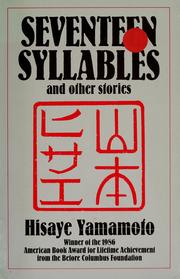
Seventeen Syllables- Hisaye Yamamoto


                                                                                                                        Pooja Agarwal
                                                                                                                        1313240
                                                                                                                         II PSEng


Exploring the themes of Japanese immigrant writings in America and the clash of cultures and generations through Hisaye Yamamoto’s story, “Seventeen Syllables”.


Hisaye Yamamoto was a contemporary Japanese American writer who was best known for her short stories through which she intimately explored the experiences and conflicts of the Japanese immigrants in America. She was born in 1921 and was a Nisei i.e a second-generation Japanese born in America to Japanese-born immigrant parents. Growing up in America, Yamamoto soon became aware of the conflict between the American culture she was exposed to and the japanese way of life that her parents tried to inculcate in her and these experiences as a second generation Japanese living in America had a lasting influence on her work. The disconnect constant conflict  between the American and Japanese culture and the generation gap between Isie parents and Nisei children was of immense concern to her and is a recurring theme in most of her works. Her most popular work is a collection of short stories called, “Seventeen Syllables and other stories” which was published in 1988.

Yamamoto's stories are often compared to the poetic form, haiku, described as "layered in metaphor, imagery, and irony, but never wordy or given to digression."
The stories in the above mentioned collection mostly deal with the experiences of first generation Japanese immigrants (Issei) and their Nisei children. The title is drawn from one of the stories within the collection and refers to the structural requirements of Japanese haiku poetry. Many of the stories have admittedly autobiographical content, making references to the World War II Japanese internment camps, to life in Southern California during the 1940s and ‘50s, and to the experience of being a writer.

“Seventeen Syllables” is Yamamoto’s most popular and definitive short story through which she discusses the the relatively restrained interaction between Issei (first generation) and Nisei (second generation) as a result of both cultural prescription and language barrier and the limited status of Japanese women who immigrated to America after marriage. The story traces the strained and disconnected relationship between Rosie and her Isei mother, Mrs Tome Hayashi. Rosie grows up attuned to the American culture and is more comfortable in english than she is in her native language-Japanese. She struggles to grasp the essence of Japanese culture,language and poetry that is central to her mother’s life. Mrs Hayashi is a talented writer and writes Haikus for the local Japanese newsletter. One day during the harvest season, the editor of the newspaper visits Mrs Hayashi and rewards her with a Hiroshige print due to her contributions. However, since it is in the middle of harvest season, her husband is irked by the fact that instead of helping in the field, his wife is wasting her time receiving presents for her hobby.and burns it. Mr Hayashi doesn’t support his wife’s talent and is infact so angry that he burns the painting given to her by the editor. We later learn that Mrs Hayashi feels stuck in her loveless marriage and only married Rosie’s father because her wealthy lover in Japan rejected her after she gave birth to a stillborn child. Fearing that Tome’s reputation is ruined, an arranged marriage is organized by her aunt who resides in the US. Tome asks Rosie to refuse marriage due to the experiences which she has undergone.

In this story, Yamamoto explores some pertinent aspects of the Japanese-American experience. The main themes of the story are the gap between the older generation of Japanese immigrants and their children who grow up as Americans. There is an apparent clash between these two generations since the former practices the ancient Japanese way of life while the latter practices the modern American culture. The latter generation views the ancient one as backward and it ignores many essential aspects of culture which it is expected to experience This divide is further emphasised by the language barrier depicted in the story. For Tome, Japanese is the most natural form of communication and infact an art for her authorial sensibilities, however her daughter Rosie has limited knowledge of Japanese due to her socialization into the American way of life and prefers english over Japanese. Further, Rosie is unable to grasp her mother’s need to write Haikus and practice her japanese culture while Mrs Hayashi fails to accept the fact that her daughter is growing up in an individualistic,highly independent society which is stark contrast to her familiar Japanese culture.

This generational gap discussed in this story is a an important aspect of many Japanese-Americans’ lives and has been a general concern for most Japanese-American writers.
Another, theme seen in the story is that of the position of women in Japanese-American families. Here we see that Mrs Hayashi is stuck in a loveless marriage where her husband does not support her talents and she struggles to live in a culture so vastly different from the one she grew up in. This seems to be the case for a lot of Japanese women who settled in America after an arranged marriage, where they had to adapt to a new way of life with little support from people around them.

Thus, by examining Yamamoto’s story we gain a better understanding of the Japanese-American experience and how American culture has influenced Japanese immigrants’ thought and writing.


Sources: